
Keeping tire pressure in range matters on road loops, commutes, gravel paths, and garage checkups. A good gauge also saves time, since you can read the number once instead of guessing by thumb pressure. This roundup focuses on designs that suit different valve types, pressure ranges, and storage habits.
You’ll see digital and analog options here, plus compact pencil styles for tool kits and a dedicated Presta model for narrow bike valves. The trade-off is simple, some gauges are broader in use while others are more specialized. That split makes the list useful for mixed households and dedicated cyclists alike.
The Shortlist At A Glance

HYVOHEX 200 PSI Digital Tire Pressure Gauge (Yellow)

JACO BikePro Bike Tire Pressure Gauge 160 PSI (Road Bike & BMX Series)

JACO BikePro Bike Tire Pressure Gauge 60 PSI (MTB Series)
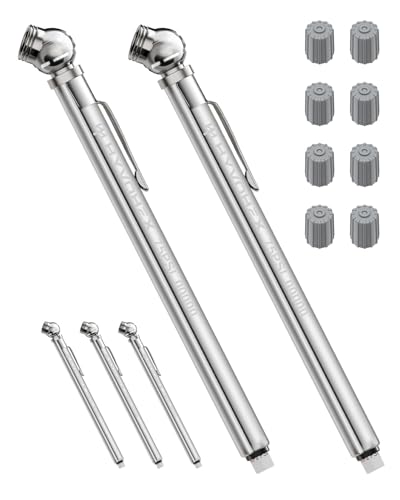
Pencil Tire Pressure Gauge 2 Pack with Valve Caps

AstroAI Pencil Tire Pressure Gauge 2 Pack with Case

AstroAI Pencil Tire Pressure Gauge 3 Pack with Case

RVZONE Mini Digital Tire Pressure Gauge 3 to 99 PSI

GODESON Presta Tire Pressure Gauge
More Details On Our Top Picks
The HYVOHEX digital gauge fits the garage that handles more than one kind of vehicle, since its 200 PSI ceiling goes well beyond bicycle use. The LED display is the main draw here, because a backlit screen is easier to read in a dim shed or at the curb before sunrise.
AAA batteries are included, so you’re not pairing the purchase with an extra accessory hunt. The trade-off is that digital convenience adds battery dependence, while a brass analog gauge like the JACO models keeps going without power.
Strong Points
- LED readout improves visibility in low light.
- 200 PSI range covers bikes, cars, and larger tires.
- AAA batteries are part of the package, which simplifies setup.
- Digital format gives you a quick, plain-number readout.
Points To Note
- Batteries introduce one more item to watch over time.
- It’s broader than a bike-only gauge, so it can feel larger in a saddle bag.
Feature Rundown
Who It Suits Best
Commuters and home garages that handle bicycles plus other vehicles get the most out of this one.
Where A Sibling Pick Shines
JACO BikePro Bike Tire Pressure Gauge 160 PSI fits road cyclists who want an analog dial with no battery upkeep.
Road cyclists usually care more about repeatable readings than bells and whistles, and this JACO dial leans hard into that need. The 2-inch glow-in-the-dark face is easier to read than a tiny pointer gauge, while the brass neck and reset button make the lock-on reading feel more controlled.
Its ANSI-calibrated accuracy claim and battery-free layout put it in a different lane from the HYVOHEX digital pick. The honest read is that the analog format asks for a bit more visual attention, but that also removes battery management from the equation.
What We Like
- Large dial is easier to read quickly.
- Glow-in-the-dark face helps in low light.
- Presta and Schrader chucks widen compatibility.
- No battery requirement keeps upkeep simple.
- Locking reading is useful for careful inflation checks.
Worth Noting
- Analog reading takes a steadier eye than a digital screen.
- Its bike-focused format may feel more specialized than the HYVOHEX gauge.
Core Details
Made For
Road bike and BMX owners who want a straightforward analog gauge with broad valve compatibility.
Another Choice May Suit
RVZONE Mini Digital Tire Pressure Gauge 3 to 99 PSI is a better match for a compact digital readout in a multi-vehicle kit.
Where the road-bike JACO model climbs to higher pressure, this MTB version keeps the scale centered on lower-range tires. That matters on trail bikes, since the 2-inch dial is tuned to a pressure band that better matches mountain setups and makes small adjustments easier to track.
It shares the same battery-free, lock-in reading behavior as the 160 PSI JACO, so upkeep stays simple. You may find the narrower ceiling a benefit rather than a limitation, assuming your bike lives in the low-pressure side of the category.
Highlights
- Lower pressure range aligns with mountain bike needs.
- Glow-in-the-dark dial supports early or late trail prep.
- Presta and Schrader chucks improve versatility.
- No batteries means one less maintenance item.
Areas To Watch
- Not as suitable for higher-pressure road setups as the 160 PSI JACO.
- Analog reading still asks for careful eye alignment.
Feature Snapshot
Best Suited To
Trail riders and mountain bike setups that sit in a lower pressure band.
Swap It Out When
JACO BikePro Bike Tire Pressure Gauge 160 PSI is the better fit for road bikes that need a higher ceiling.
This HYVOHEX pencil set keeps things old-school in the useful sense, with a slim metal body and a built-in deflator valve. That makes it a strong garage companion for quick top-offs, especially on cars, pickups, RVs, and bicycles where you want a straight mechanical read.
The four-sided scale rod should help with fast viewing from awkward angles, which is handy in tight wheel wells or beside a crowded workbench. The trade-off is that pencil gauges are more basic than the dial and digital options above, so they suit straightforward checks more than frequent fine-tuning.
Bright Spots
- Two-piece pack gives you a backup gauge.
- Deflator valve helps trim excess pressure.
- Stainless steel body supports a sturdy feel.
- Dual PSI and kPa scales suit different habits.
- Four-sided rod makes angle changes less fussy.
Softer Spots
- Mechanical pencil format is more basic than the JACO dials.
- It’s best for plain pressure checks, not feature-heavy use.
- Small gauges can be easy to misplace in a busy tool kit.
Spec Overview
Right Fit For
Anyone who wants a simple mechanical gauge for mixed garage duty.
Look Elsewhere When
HYVOHEX 200 PSI Digital Tire Pressure Gauge (Yellow) suits you better for a lit display and broader pressure range.
AstroAI’s two-pack is a step up from the basic pencil style because it adds a case and a narrower accuracy span claim. That kind of detail matters in mixed-vehicle households, where one gauge may live in a glove box and the other stays with a bike pump or tool drawer.
The stainless steel body and metal nozzle point to a sturdier feel than plastic-bodied pocket gauges, though the format still stays slim and easy to store. It sits between the simpler HYVOHEX pencil set and the more quantity-heavy AstroAI three-pack, so the right choice depends on how many places you want one stashed.
Best Bits
- Two gauges plus a case improve organization.
- Stainless steel body suggests solid day-to-day wear.
- Metal nozzle adds a more substantial connection point.
- Three measurement labels broaden compatibility with different habits.
Small Caveats
- Still a pencil gauge, so it’s less feature-rich than the JACO dials.
- Case adds another item to keep track of in storage.
Details At A Glance
Whose Shelf It Belongs On
Households that want a compact mechanical gauge set with a tidy storage case.
Where A Sibling Pick Shines
AstroAI Pencil Tire Pressure Gauge 3 Pack with Case suits you better when you want more spares across multiple cars or pumps.
This version follows the same AstroAI formula as the two-pack, but the extra gauge makes it easier to split duties across a garage, workshop, and trunk. That’s useful for routines where one tool tends to disappear just when the family needs it most.
The stainless body, metal nozzle, and included case keep the package organized without adding digital complexity. Compared with the HYVOHEX pencil gauge, it’s more about redundancy and storage control than new features, and that’s exactly why it makes sense for a busy household.
Upsides
- Three gauges cover multiple storage spots.
- Included case helps prevent clutter.
- Metal construction points to better wear resistance.
- Useful for households that share maintenance tools.
Room For Improvement
- The format stays basic compared with the JACO dial gauges.
- Three pieces can be overkill for a single-bike setup.
- Keeping all three together takes a little storage discipline.
Core Details
The Right Fit
Shared garages and tool-heavy households that want backups rather than a single gauge.
Not Your Match When
JACO BikePro Bike Tire Pressure Gauge 60 PSI fits mountain bike owners better because its range is more specialized.
The RVZONE mini digital gauge leans into portability, which is useful for glove boxes, travel kits, and bike baskets where bulk gets in the way fast. The backlit LCD is the useful part here, because a lit screen takes some strain out of reading numbers in a dark parking space or under a trailer awning.
Its 3 to 99 PSI span and four settings make it more flexible than a bike-only tool, though it is still small enough to feel purpose-built for easy storage. Compared with the HYVOHEX digital gauge, this one looks like the more pocketable option, while giving up some of the broader 200 PSI reach.
Reasons To Buy
- Mini size makes it easy to carry.
- Backlit LCD improves visibility at night.
- Four settings add everyday flexibility.
- Fits well in travel kits and glove compartments.
Minor Gripes
- Lower ceiling than the HYVOHEX digital gauge.
- Compact bodies can be easier to misplace.
- Digital use still brings battery upkeep into the picture.
Feature Card
Built With In Mind
Travel-minded cyclists and drivers who want a compact digital gauge with easier nighttime reading.
Reach For A Different Pick When
HYVOHEX 200 PSI Digital Tire Pressure Gauge (Yellow) makes more sense for a higher pressure ceiling and a broader garage role.
The GODESON gauge is the specialist in this lineup, and that narrow focus is its entire point. It works only with Presta valves, so you get a dedicated 2.0-inch dial and a pressure range better matched to mountain bikes and other low-pressure setups.
The Bourdon tube mechanism is a mechanical design that does the measuring without batteries, which keeps the tool simple for routine bike care. The trade-off is obvious: the specialization is excellent for Presta bikes, but it leaves Schrader users needing one of the more versatile JACO or AstroAI picks.
Positives
- Presta-only design suits dedicated bike use.
- Large dial helps with quick reading.
- Mechanical operation avoids battery upkeep.
- Dual-scale face supports PSI and bar habits.
- Rubber cover adds a softer outer layer for handling.
Honest Caveats
- It will not work with Schrader valves.
- Range is limited compared with broader gauges.
- The small air bleeder button may need a careful touch.
- Rubber covers still benefit from clean storage away from grit.
Quick Facts
Who Should Grab It
Presta-valve bike owners who want a dedicated low-pressure gauge for regular bike care.
A Better Fit Elsewhere
JACO BikePro Bike Tire Pressure Gauge 160 PSI is the smarter all-around choice for riders who also need Schrader compatibility.
How To Choose The Right Bike Tire Gauge
Valve Match Comes First
Presta and Schrader are the two valve types that matter most here. Presta is the slimmer bike valve used on many road and mountain setups, while Schrader is the wider style found on many cars and some bikes. A gauge that only fits one valve type, like the GODESON Presta model, gives you more focus but less flexibility.
Mixed households usually benefit from dual-chuck gauges such as the JACO BikePro series. That way, you don’t need separate tools for each bike or spare wheel. The trade-off is a slightly bulkier body.
Readability Changes The Experience
Digital screens and large dials both solve the same problem, but they solve it differently. A backlit LCD, like on the HYVOHEX and RVZONE gauges, helps in dim garages and late-evening checks. An analog dial, like the JACO models, avoids battery dependence and often gives a steadier visual read.
For frequent roadside use, plain visibility matters more than fancy features. A larger face or lit screen makes pressure checks less fussy, especially when you’re standing in bad light beside a curb or trailhead.
Pressure Range Should Fit The Wheel
Road tires and BMX tires often sit higher than mountain bike tires, so range matters more than many shoppers expect. The 160 PSI JACO gauge suits high-pressure use, while the 60 PSI MTB version better matches lower-pressure trail setups. The GODESON Presta gauge sits even lower, which works well for dedicated bike tires that don’t need a broad ceiling.
Buying far more range than you need usually adds size without adding much value. That’s why a mountain rider may prefer the 60 PSI JACO over the 200 PSI HYVOHEX, while a mixed garage may appreciate the wider digital span.
Storage And Maintenance Still Count
Pencil gauges and mini digitals are easier to stash in a glove box, jersey pocket, or tool drawer. Larger dial models are friendlier to read, but they claim more space and usually deserve a steadier home in the garage. A case, like the one with the AstroAI sets, helps keep small parts together.
Battery-free gauges reduce upkeep, which is useful for tools that sit unused between rides. Digital models ask for a little more attention, while mechanical bodies ask for cleaner storage and a careful eye on valve seals and moving parts.
Things Worth Knowing First
Where Shoppers Go Wrong
One common mistake is choosing a gauge by price alone and then discovering the valve fit is wrong. Another is picking a pressure range that doesn’t match the bike, which leaves road riders with low-resolution tools and mountain riders with oversized hardware. Both problems are easy to avoid by checking valve type and target PSI before anything else.
Size matters too. A compact gauge is handy for travel, but tiny bodies are easier to misplace and smaller faces can be slower to read in poor light.
Where The Extra Money Goes
Higher-tier gauges usually pay for larger faces, better housings, extra valve compatibility, or cleaner reading behavior. That’s why the JACO dials feel more specialized than the basic pencil styles, and why the AstroAI sets add value through cases and extra units. The money often buys convenience, not magic.
Spending up makes sense for daily riders, shared garages, or anyone who wants less fuss at the valve. For occasional checks, a simple pencil gauge can still be the sensible route.
Frequently Asked Questions
Do you need a bike-specific gauge?
Bike-specific gauges help most when tire pressure sits in a narrow range or the valve type is Presta. A broader automotive gauge can still work, but the readout may be less tailored to bicycle use.
What is the difference between Presta and Schrader?
Presta valves are slimmer and common on many bikes, while Schrader valves are wider and familiar from many cars. A dual-chuck gauge covers both, while a Presta-only model is built for a narrower setup.
Is digital or analog better?
Digital gauges are easier to read in low light, especially with a backlit screen. Analog gauges avoid battery upkeep and often suit riders who prefer a mechanical dial.
What PSI range should you choose?
Road bikes often need a higher ceiling than mountain bikes, so a wider range helps there. Low-pressure trail setups do better with a gauge that focuses on the lower end.
Are pencil gauges accurate enough for regular bike care?
Pencil gauges can work well for routine checks, especially in simple garage setups. A dial or digital model usually gives you a clearer reading if you want easier repeatability.