
Moving bikes shouldn’t turn into a weekend puzzle. You want a rack that matches your hitch size, bike weight, tire width, and how often you need rear access, whether that’s a school run with two bikes or a road trip with a pair of e-bikes.
That’s where the right automobile bike rack matters. Some are built for simple family hauling, others lean into heavy e-bike support, and a few add ramps or tilt functions that make loading far less awkward.
Quick Look At The Shortlist
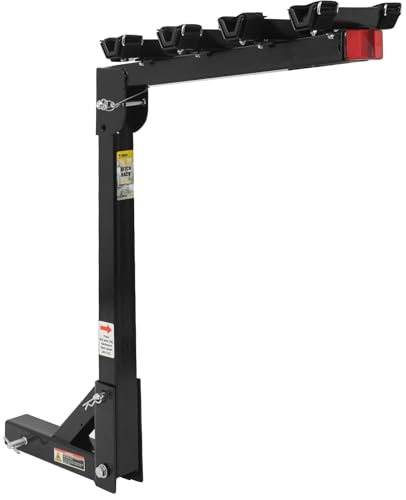
MaxxHaul Hitch Mount 4 Bike Rack 150 lb Capacity
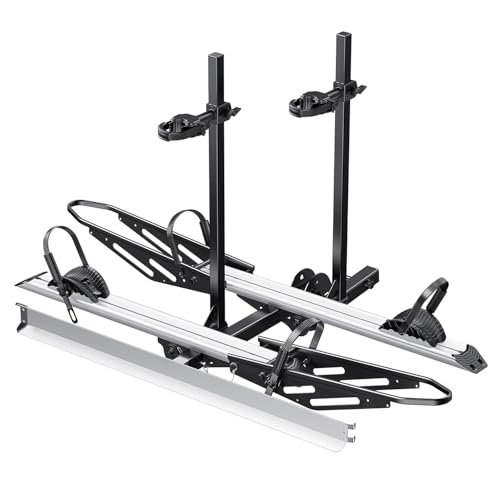
Young Hitch Mount Bike Rack with Ramp, 200 lbs. Capacity

Bike Racks for Ebikes, Fat Tire Bike Rack for Tow Hitch 2-Bike 160 lbs Capacity
Amazon Basics 4-Bike Hitch Rack with 2″ Hitch

Upgrade 2.0 Hitch Bike Rack 240 lbs Max Load

FORWODE Bike Rack Hitch for Car, 200 LB 2-Bike Racks

2 Bike Hitch Rack for Car, 160 lbs Platform E-Bike Carrier

CyberRack EBike Rack for 2 Bike, 200 lbs Capacity
JOYTUTUS Hitch EBike Rack with Ramp for 2 E-Bikes, 200 LBS Capacity
More Details On Our Top Picks
MAXXHAUL’s four-bike layout suits family weekends and carpool-style rides, especially when you need to move several bikes without jumping to a larger trailer setup. The swing-down design matters in daily use because it gives you a better shot at the rear hatch, which is handy in a busy driveway or at a trailhead parking lot.
The 150-pound capacity gives this rack a clear role, and that role is broad but not unlimited. You may find it most sensible for standard bikes and lighter mixed loads, while heavier e-bikes are better matched to the higher-capacity racks later in this list.
Strong Points
- Four-bike capacity helps on group outings and family trips.
- Swing-down access makes cargo-area reach less awkward.
- Fits cars, trucks, SUVs, and minivans for broad vehicle compatibility.
- Safety reflector adds a small visibility cue for roadside loading.
- Heavy-duty framing should suit regular weekend use well.
Things To Consider
- 150 pounds total is fine for lighter bikes, but not the right lane for loaded e-bikes.
- A four-bike carrier needs more rear-space planning than a two-bike model.
- Hitch racks tend to need periodic bolt checks, especially after rough roads.
Key Specs
Who It Suits Best
Weekend cyclists, families, and casual group riders get the most from this rack.
A Better Fit Elsewhere
Young Hitch Mount Bike Rack with Ramp, 200 lbs. Capacity makes more sense for e-bike owners who want loading help and a stronger weight ceiling.
Ramp help changes the whole experience here, because lifting a heavy e-bike onto a hitch rack is where many setups start to feel clumsy. This one is aimed at that problem directly, and the 200-pound capacity gives it room for two heavier bikes without feeling cramped.
Compared with the MAXXHAUL rack, this model is less about hauling a crowd and more about making two substantial bikes easier to manage. Owners with RVs, trailers, or taller rear openings may appreciate that the ramp reduces the awkward part of loading, though the trade-off is a larger, more involved setup.
What We Like
- Ramp-assisted loading reduces the lift needed for heavier bikes.
- 200-pound capacity supports two substantial e-bikes.
- Works with fat tire and standard bikes for flexible pairing.
- Fits cars, SUVs, RVs, and trailers with a 2-inch receiver.
- Good match for riders who travel with heavier frames or batteries.
Worth Noting
- The ramp adds bulk, so storage takes more space than a simpler carrier.
- Loading hardware usually needs extra attention to keep the ramp stable.
- Best suited to two bikes, so it is not the answer for larger families.
Feature Snapshot
Made For
Heavier e-bike owners who want less lifting and a two-bike setup will feel at home with this rack.
Consider Something Else When
MAXXHAUL Hitch Mount 4 Bike Rack 150 lb Capacity works better for families who care more about carrying four lighter bikes than about ramp-assisted loading.
This TANX rack leans into the middle ground: enough capacity for two bikes, enough strength for heavier setups, and enough movement control to feel steadier than a bare-bones carrier. The wobble-free and tilting language matters because hitch racks can feel fussy when you’re loading at the curb or trying to reach the tailgate.
Compared with the Young rack, you give up the ramp but gain a simpler shape that should appeal to shoppers who want less hardware to manage. It fits the sort of weekend use where you want a dependable carry solution without a more elaborate lift-and-roll routine.
Highlights
- Two-bike format keeps the rack compact for smaller garages.
- 160-pound total capacity gives useful room for heavier bikes.
- Tilt function helps with rear access on many vehicles.
- Foldable design makes storage easier between trips.
- Works with standard and fat tire bike setups.
Room For Improvement
- No ramp means lifting stays part of the loading routine.
- Two-bike capacity may feel tight for bigger family outings.
- Moving parts deserve occasional cleaning after dusty trail use.
Feature Rundown
Right Fit For
Two-bike e-bike owners who want a simpler rack than a ramp model should look closely here.
Swap It Out When
Young Hitch Mount Bike Rack with Ramp, 200 lbs. Capacity suits you better when lifting is the part you want to avoid.
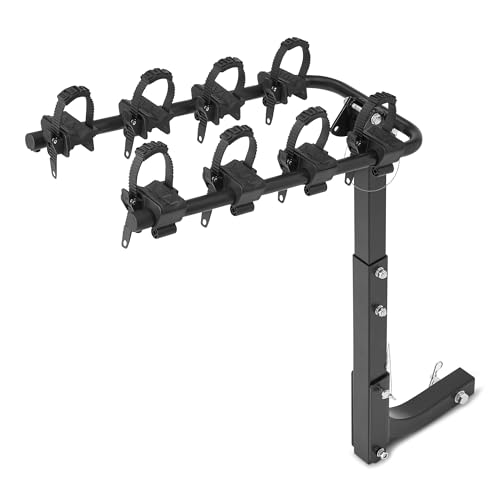
This Amazon Basics rack keeps the formula plain in a good way, with a steel frame, foldable shape, and anti-rattle stability aimed at everyday hauling. Anti-rattle hardware matters because it helps reduce the loose, shaky feeling that can show up on rough pavement or patched city roads.
Compared with the TANX and MaxxHaul picks, this one sits in the middle as a straightforward four-bike carrier with less emphasis on e-bike specifics. That makes it a sensible choice for households that mostly move standard bikes and want something easy to store between uses.
Best Bits
- Four-bike capacity handles family or group outings well.
- Foldable frame helps the rack tuck away more neatly.
- Anti-rattle design supports steadier highway travel.
- Steel construction should stand up to repeated use.
- 2-inch hitch fit keeps compatibility simple.
Softer Spots
- 132-pound limit is lower than several two-bike e-bike racks here.
- Four-bike racks take more care to load evenly.
- Steel can add weight, so handling it off the vehicle takes some effort.
Core Details
Built With In Mind
Households that mainly carry standard bikes and want a simple four-bike solution will get the most from this rack.
Look Elsewhere When
MaxxHaul Hitch Mount 4 Bike Rack 150 lb Capacity suits you better if swing-down rear access matters more than a basic foldable frame.
GOEHNER’s rack pushes into heavier-duty territory with a 240-pound ceiling and 60 pounds per bike, so it’s aimed at more demanding loads than the Amazon Basics carrier. The hanging style also keeps the frame compact compared with a platform rack, though that trade-off usually asks more of your bike frame shape and strap setup.
For RVs, trucks, and SUVs, this kind of capacity is useful when your bikes are not especially light and you want a rack that feels built for regular hauling. The dual-locking detail should appeal to shoppers who want a more controlled attachment setup, even though a hanging rack typically takes a little more care during loading.
Reasons To Buy
- 240-pound total load gives generous room for two bikes.
- 60 pounds per bike suits heavier frames better.
- Dual locking adds a more secure-feeling attachment setup.
- Hanging format stays less bulky than many platform carriers.
- Works with cars, SUVs, trucks, and RVs.
Areas To Watch
- Hanging racks can be less forgiving with unusual bike frame shapes.
- Two-bike capacity limits use for larger family outings.
- Loading straps and attachment points need regular inspection.
Details At A Glance
The Right Fit
Shoppers with heavier bikes and a need for a two-bike hanging carrier should look here first.
Where A Sibling Pick Shines
CRAVOT CyberRack EBike Rack for 2 Bike, 200 lbs Capacity suits you better if a platform-style carrier feels easier to live with.
FORWODE leans into the details that make a rack easier to trust on real roads, especially the coded lock and tilting design. A coded lock is a keyed-lock alternative that uses a numeric code, and that helps simplify access without carrying another metal key on every ride.
The 200-pound capacity and 5-inch fat tire support give it clear e-bike credentials, while the wobble-free language points to steadier travel on rougher pavement. Compared with the GOEHNER hanging rack, this one feels more convenience-focused and a better match for riders who want a platform-style setup with fewer compromises.
What We Like
- Coded lock keeps access simpler than a keyed setup.
- Tilting frame helps with rear hatch access.
- 200-pound capacity works well for heavier bike pairings.
- Supports fat tires up to 5 inches wide.
- Platform style usually feels steadier for e-bikes.
Small Caveats
- Platform racks can take more space in storage.
- Lock combinations need remembering, which some people prefer less than a key.
- Moving joints and tilt points benefit from routine cleaning after wet rides.
Quick Facts
Whose Shelf It Belongs On
This makes sense for e-bike owners who want a coded lock and a steadier platform build.
A Better Fit Elsewhere
Young Hitch Mount Bike Rack with Ramp, 200 lbs. Capacity suits you better if loading assistance matters more than locking convenience.
CRINDAR’s rack is built around the small conveniences that matter on busy days, like tilting rear access and foldable storage. Those details sound modest, but they save you from removing the whole rack every time you need the hatch, and that’s a real difference in day-to-day use.
It sits below the 200-pound e-bike carriers in raw capacity, yet the 160-pound platform setup is still enough for many heavier two-bike loads. For commuting couples or weekend riders who want a simpler footprint, it feels like a sensible middle path.
Positives
- Platform layout gives a stable base for two bikes.
- Tilt feature helps you reach the rear of the vehicle.
- Foldable storage keeps garage clutter down.
- Fits up to 5-inch fat tire e-bikes.
- Anti-wobble stability is useful on longer drives.
Minor Gripes
- 160-pound limit leaves less margin than 200-pound options.
- Platform racks generally take more room than hanging racks.
- Hinge and fold points may need occasional wipe-downs after dusty trips.
At A Glance
Best Suited To
You get the most from this rack when you want a stable two-bike platform without extra bulk or ramp hardware.
Skip It When
FORWODE Bike Rack Hitch for Car, 200 LB 2-Bike Racks makes more sense if a coded lock and higher capacity sit higher on your list.
CRAVOT’s CyberRack is the sort of two-bike carrier that makes sense for mixed households, because it pairs a 200-pound rating with support for 5-inch fat tires. That gives you room to handle heavier bikes without moving into a much larger four-bike format.
Compared with the CRINDAR platform rack, this one leans more toward broad fit range than storage convenience. That trade-off can work well for you if garage space is tight but your bikes vary quite a bit in shape or frame style.
Upsides
- 200-pound capacity is useful for heavier bike combinations.
- Supports fat tires up to 5 inches wide.
- Two-bike setup keeps the footprint more manageable.
- Fits cars, trucks, SUVs, minivans, RVs, and trailers.
- Works well for households with more than one vehicle type.
Points To Note
- The broader fit range may come with a more involved setup than a bare-bones rack.
- Two-bike capacity still limits larger group travel.
- Storage and handling usually feel easier with fewer moving parts cleaned and checked between trips.
Spec Overview
Who Should Grab It
Multi-vehicle households that move heavier bikes and want broad hitch compatibility will appreciate this one.
Reach For A Different Pick When
2 Bike Hitch Rack for Car, 160 lbs Platform E-Bike Carrier fits better if you want a simpler platform rack with a more compact storage feel.
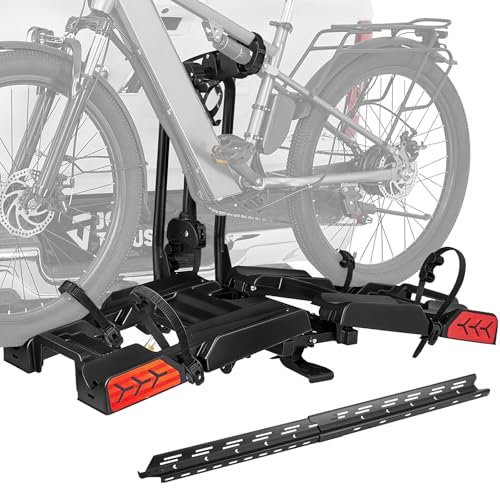
JOYTUTUS combines ramp loading with a 200-pound e-bike rating, so it’s built for riders who move heavier bikes and don’t want to muscle them onto the carrier. The foldable, tilting shape helps on the road and in storage, which matters more than it sounds once the rack becomes part of your regular routine.
Compared with the Young rack, this one keeps the ramp advantage while staying in the same broad capacity class. That makes it a solid fit for long-distance travel, especially for bikes with wider tires and more awkward lift points.
Bright Spots
- Ramp support eases loading for heavier e-bikes.
- 200-pound capacity suits two substantial bikes.
- Tilting frame helps with rear access.
- Foldable construction is convenient between road trips.
- Fits up to 5-inch fat tires.
Honest Caveats
- The ramp makes the overall setup larger than simpler racks.
- Two-bike capacity is enough for pairs, not groups.
- Fold points and rolling parts tend to need periodic cleanup after dirty trips.
Feature Card
Perfect Match For
You get the most from this rack when you travel with two heavy e-bikes and want ramp assistance built in.
Another Choice May Suit
FORWODE Bike Rack Hitch for Car, 200 LB 2-Bike Racks suits you better if a coded lock matters more than ramp convenience.
How To Choose The Right Automobile Bike Racks
Match The Rack To Your Bike Weight
Start with the heaviest bike you plan to carry, not the lightest one sitting in the garage. E-bike batteries and stout frames add up quickly, so a rack with a comfortable margin is easier to live with than one that’s always near its edge.
Two-bike racks with 200-pound ratings suit many electric setups, while lighter four-bike racks make more sense for standard bicycles. That split is the first big decision, and it usually matters more than extra paint or a fancy label.
Think About Access And Loading
Tilt functions and swing-down designs matter because rear access is something you’ll use often, not just once. In a crowded driveway, being able to reach the cargo area without unloading everything can save a lot of hassle.
Ramps are worth a closer look for heavy e-bikes or taller tailgates, since they remove the heaviest lift from the process. The trade-off is bulk, so a ramp rack tends to live in a different lane from a simpler hanging carrier.
Receiver Size And Vehicle Fit Still Count
A 2-inch receiver is the common fit across this roundup, and that makes compatibility easier to predict. Still, you should check how far the rack extends past the bumper and whether your rear hatch can open cleanly with bikes mounted.
Cars, SUVs, trucks, RVs, trailers, and minivans all show up here, but the right rack depends on your vehicle’s tail shape as much as its hitch. A long rear overhang can make a compact rack feel less awkward than a bulkier one.
Storage, Security, And Real-World Maintenance
Foldable frames help a lot in smaller garages, especially when the rack spends more time parked than mounted. Locks, coded or keyed, are useful for peace of mind during stops, though they still need routine checking just like any moving hardware.
Dust, rain, and road grime collect around tilt joints, straps, and folding points. A quick wipe-down and occasional fastener check keep the rack feeling orderly, and that matters almost as much as the load rating itself.
Things Worth Knowing First
Where Shoppers Go Wrong
Many people focus on total capacity and forget bike shape. A rack that handles the weight still may not suit an odd frame, a deep step-through, or a very wide tire.
Another common miss is ignoring rear access. A rack can look fine on paper and still become annoying every time you need the hatch or tailgate.
The Case For Spending Up
Higher-tier racks usually pay for stronger hardware, better tilt mechanisms, and loading help such as ramps. That extra spending often shows up in smoother handling and less drama when your bike is heavy or your trips are long.
Paying more makes sense for e-bike owners, frequent travelers, and households that use the rack every week. For occasional rides with lighter bikes, a simpler model can be the more sensible move.
Frequently Asked Questions
What size hitch do most automobile bike racks use?
Most of the racks in this roundup use a 2-inch receiver. That size is common on many SUVs, trucks, and crossovers.
Are platform racks easier to live with than hanging racks?
Platform racks usually feel steadier for heavier bikes and fat tires. Hanging racks can be lighter and simpler, but they ask more of the bike frame shape.
Do tilt features really matter?
They matter a lot for rear access on hatchbacks and SUVs. Without tilt, you often have to work around the whole rack instead of opening the rear normally.
What matters more, weight limit or bike count?
Weight limit comes first, because a rack can only carry what its structure allows. Bike count matters after that, once you know the load safely fits your setup.
Are ramps worth it for e-bikes?
Ramps are useful when lifting feels awkward or the bike is simply too heavy to manage comfortably. They also help keep loading more controlled in driveways and parking lots.
Closing Thoughts
For automobile bike racks, the smartest choice comes from matching the rack to the way you actually travel. Families hauling lighter bikes can stay with simpler four-bike carriers, while e-bike owners usually get more value from a two-bike rack with a stronger load rating, tilt, or ramp support. Think about rear access, hitch size, and how much storage space you’re willing to give up. That makes the shortlist easier, and it keeps you from paying for features you’ll rarely use.